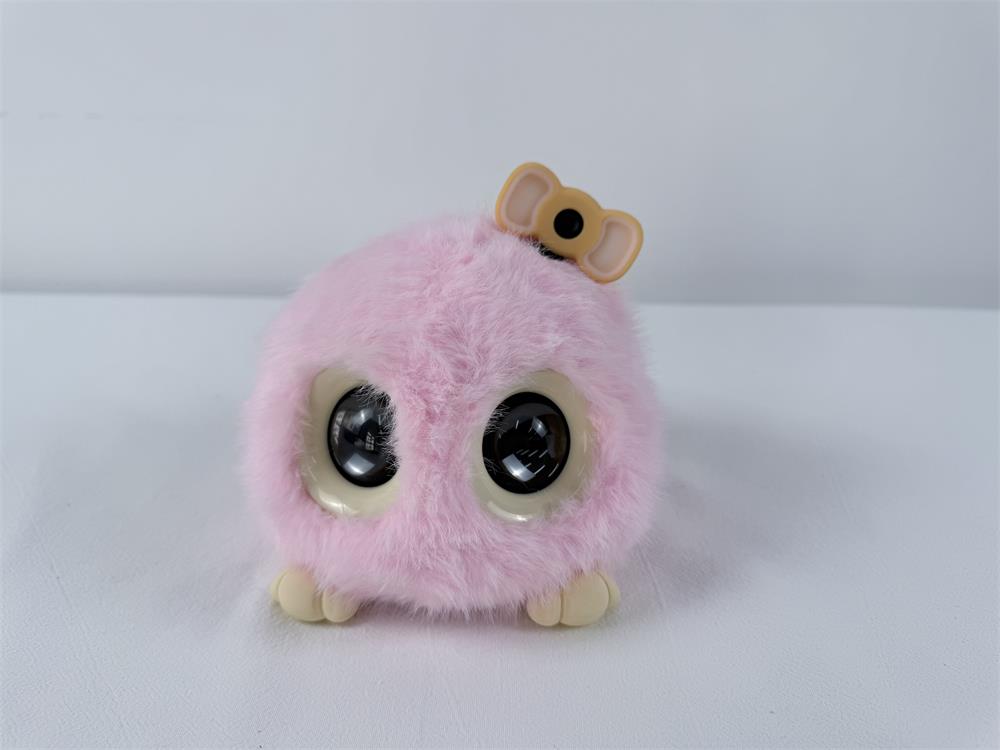
1. From Single Product to Series: TATA Is the Turning Point of SPAEXI's AI Pet Strategy
Before the TATA series, SPAEXI's AI pet products were mostly in the exploration stage, and market awareness had not yet formed a clear label. The launch of the TATA series changed this situation.
It established the concept of a "series" for SPAEXI's AI pet products for the first time and formed a complementary matrix through two products — the DF583 Piyta and the DF585 Buita. This is not simply an increase in model numbers; it means SPAEXI has begun to operate the AI pet track with a "product family" mindset: sharing the underlying platform while differentiating upper-level functional and emotional selling points, thereby covering a wider audience at lower cost.
2. Technological Innovation: Lightweight RTOS + Multi-Model Integration Lowers the Barrier for AI Pets
The TATA series' innovation in technical route is first reflected in its device-cloud collaborative architecture. Both products run the RTOS real-time system with a 240MHz main control chip. The device side only handles real-time tasks such as sensors, motors, and audio, while complex semantic understanding and content generation are handed over to cloud large models.
This design brings three direct improvements:
-
Lower cost: Not stacking local computing power gives AI pets the opportunity to enter the mass consumer price range;
-
Better experience: By integrating Doubao, Qwen, and ChatGPT, users can switch between different models and enjoy richer conversational capabilities;
-
Global adaptability: Support for 20 languages allows the same hardware to enter different language markets, significantly reducing localization costs.
It can be said that the TATA series solves the long-standing contradiction between "high performance and high cost" faced by AI pet robots through a "light device + strong cloud" approach.
3. Product Form Innovation: The First Clear Division Between the Visual School and the Emotional School
One of the most important advances of the TATA series is that it enables AI pet robots to begin a two-way differentiation toward "personalization."
DF583 Piyta: Breaking boundaries with visual capability.
It is equipped with a 100° fisheye lens, introducing the ability to "see" into desktop companionship scenarios. This means the AI pet is no longer just a voice terminal but can also take on practical functions such as remote video interaction, wide-angle home monitoring, and environmental perception. The product's value boundary extends from "chatting" to "caregiving."
DF585 Buita: Upgrading emotional expression.
It adopts dual 1.28-inch TFT screens, using two 240×240 screens to achieve dynamic expressions and split-screen information display. Six ID color options, including brown long fur, further strengthen the pet attribute, making the robot feel more like a companion object with "emotions and appearance preferences."
This combination of "visual school + emotional school" is not common in the AI pet industry. It marks that SPAEXI no longer treats AI pets as single-function hardware but has begun to think about why users need them and what role they should play in users' lives.
4. From Product to Ecosystem: The Platform Capability Behind TATA
The progress of the TATA series is also reflected in SPAEXI's platform capabilities.
The two products share the same underlying solution: the same RTOS system, the same chip platform, the same battery pack, the same charging interface, and the same software model interface. This highly reusable platform enables SPAEXI to:
-
Rapidly iterate new products and shorten R&D cycles;
-
Provide flexible customization foundations for OEM/ODM customers;
-
Cover channel needs in more than 80 countries with more unified quality standards.
From this perspective, TATA is not just a product series but also a technology middle platform and product methodology accumulated by SPAEXI in the AI pet field. It marks the company's upgrade from "making a product" to "building a system."
5. Industry Significance: AI Pet Robots Move from "Feature Competition" to the Era of "Scenario Definition"
The launch of the TATA series also reflects the evolution of the entire AI pet robot industry.
Early AI pets mostly centered on voice interaction, and product homogeneity was serious. As large model capabilities become widespread, simply "being able to chat" can no longer form a barrier. The progress of the TATA series lies in its use of two differentiated products to prove that the next competitive point for AI pets lies in scenario definition capability — whether you serve "monitoring," "companionship," or "decoration and emotional value."
SPAEXI's answer through TATA is: all of them, but done separately. Piyta is responsible for "practicality," Buita for "emotion," sharing the foundation while differentiating at the top. This approach provides a referable product strategy for the AI pet industry.



 Language
 Tiktok
 instagram
 Youtube
 +86 137-1500-3940
  E-mail