I. The AI Pet Market: From "Electronic Toy" to "Emotional Buddy"
In 2026, the AI pet sector is experiencing a core shift from "single‑function hardware" toward "active AI agent and emotional interaction." More young people are turning to AI for emotional support. Products combining AI with physical companionship, marketed as "emotional meal replacements" or "digital ibuprofen," are gaining popularity among younger generations.
At CES 2026, Japan's Yukai Engineering showcased its AI pet "mirumi," which became a showstopper – playfully described by visitors as the "most useless yet most tempting" AI device. At the same time, over 30 Chinese companies also brought their own AI pet toys. Tech giants like JD.com, ByteDance, and Huawei have also recognized the potential of this sector and are actively entering the space. JD.com's AI Toy Conference reportedly attracted over 600 manufacturers.
Price tiers are rapidly shifting downward. From the budget‑friendly Huawei "Smart Hanhan" and Fuzozo, to mid‑to‑high‑end products like Japan's mirumi and Casio's Moflin, AI pets now have a clear pricing spectrum. Falling costs are transforming AI toys from "premium novelty items" into "mass‑market consumer goods."
II. "Curious Cat" at the ICIF: Companionship You Can Carry
At the 22nd China (Shenzhen) International Cultural Industries Fair (ICIF) held in May 2026, an AI toy from Shenzhen District drew large crowds. The booth representative noted that both the AI Curious Cat and the AI Scruffy Cat have shown strong performance in the Yiwu market, ranking among the top five in the AI toy category.
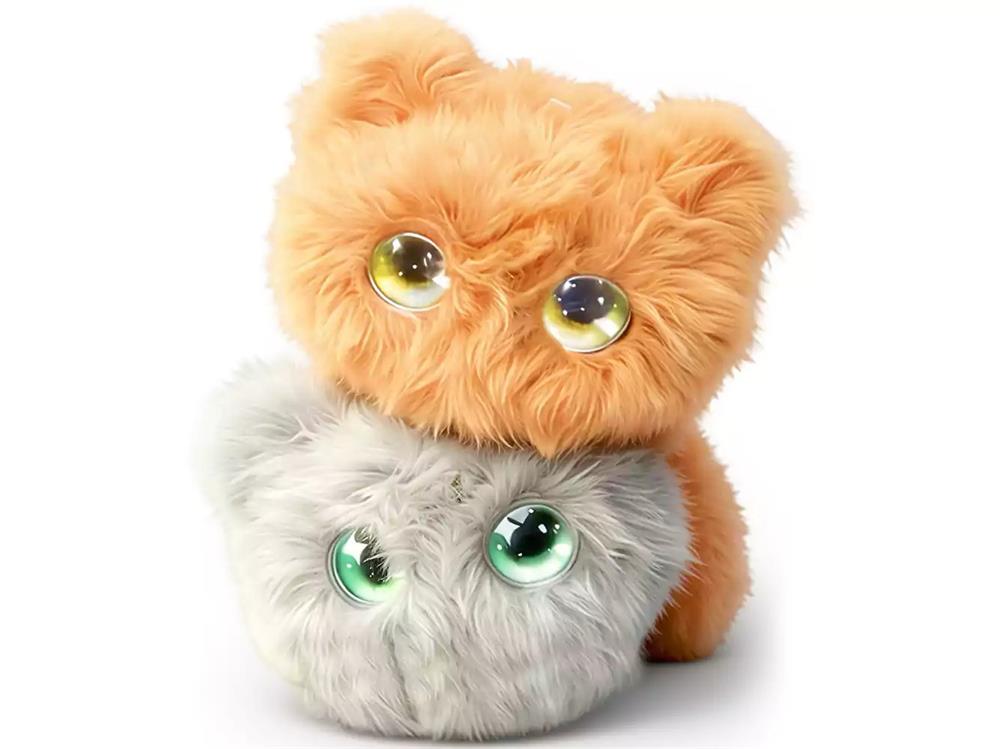
This product is SPAEXI's AI Curious Cat Hachi.
Unlike most AI pets that are confined to being "desk ornaments," Hachi introduces a concept that better aligns with the fast‑paced lifestyles of young people: "Companionship that needs no care, yet understands your every little mood better than anyone."
III. Hachi's Core Strengths: Portable, Understanding, Unrestricted
1. Clip‑on and carry – companionship everywhere
Hachi measures just 90×90×90mm with a 100mm tail, weighs only 132g, and comes with a bag clip. It's not a "desk‑only" accessory – it's a buddy you can clip onto your bag and take anywhere. Whether commuting, traveling, or just out and about, Hachi stays with you. This "carry‑able" differentiation directly addresses the real‑world need of young people for "emotional support anytime, anywhere."
2. 8 dynamic expressions – emotions written on its face
Hachi features a 0.8‑inch HD display as its exclusive "electronic eye," rendering 8 soft, cute expressions in real time – squinting when happy, tearing up when sad, yawning when sleepy. You don't need words to read its mood. Through screen expressions, dialogue content, head movements, ear motions, body gestures, and custom sound effects triggered by user emotions – Hachi expresses itself across multiple dimensions.
3. 80+ languages – companionship without borders
Powered by an AI large model, Hachi supports over 80 languages, including Chinese (with dialects like Sichuanese and Cantonese), English, Japanese, Korean, Spanish, Arabic, and more. No matter what language you speak, Hachi responds in your native tongue – truly delivering a "Sense – Understand – Express" emotional interaction loop.
4. More than just "cute" – full‑scenario intelligent companionship
Hachi's functional system is built around real companionship needs. Driven by an AI large model, Hachi is not only an emotion‑aware voice companion, but also a real‑time life information assistant, an all‑age AI learning and knowledge partner, and a storytelling entertainment buddy. One Hachi covers office, study, travel, and bedroom – all scenarios.
IV. Market Insight: When AI Companionship Moves from Desktop to Pocket
From Huawei's "Smart Hanhan" to Japan's mirumi, from Fuzozo to Casio's Moflin, the AI pet sector is transitioning from "luxury for the few" to "consumer goods for everyone." Hachi's differentiator is that it's not just a "talking plush toy" – it's a companion you can carry, one that responds through both expressions and words, and truly understands your emotions.
Some commentators note that the appeal of AI pets to young people lies not only in companionship, but also in reflecting their deep desire for connection and response. AI pets have no heartbeat, yet they sense emotions. They don't need feeding, won't get sick, and still offer interaction. They are driven by code, yet deliver an experience that feels like a soul.
As more people turn to AI for "certain companionship," Hachi's answer is simple: put companionship in your pocket, put emotions on its face, and carry warmth with you wherever you go.



 اللغة
اللغة Tiktok
 instagram
 Youtube
 +86 137-1500-3940
  E-mail