I. The "OpenClaw" Effect: AI Agents Are Fueling Mini PC Demand
In early 2026, an open‑source AI agent project called OpenClaw went viral. It sparked a buying frenzy that left Apple's Mac mini M4 out of stock nationwide, with second‑hand prices jumping from 3,700 RMB to 4,700 RMB – a thousand‑yuan premium for现货 units. Why? Because AI Agents need local computing power. As NVIDIA CEO Jensen Huang declared at GTCT 2026: "The new generation of PCs will no longer be just traditional office computers, but Agent PCs with strong AI reasoning capabilities."
Mini PCs have become the ideal hardware for running AI Agents locally due to their compact footprint, flexible deployment, high performance, and affordable pricing. Industry insiders call deploying and running these agents "raising lobsters," and the Mini PCs that host them are nicknamed "lobster cages." These ARM‑based desktop‑grade terminals can handle local AI execution, cross‑platform operations, and fully automated task processing – all while running 24/7 on low power with strong physical isolation security. In Shenzhen's Huaqiangbei electronics district alone, over 100 companies have entered the Mini PC space, with export ratios exceeding 30%. Products now reach 80 to 100 countries and regions, with Shenzhen accounting for approximately 15% of the global Mini PC market.
II. Price‑to‑Performance: The "Better Than Half" Advantage
In a traditional PC market struggling with stagnation, Chinese Mini PCs have found a winning formula: half the price, comparable performance. These compact, capable machines have precisely targeted the global demand for affordable office and light‑computing solutions. Their prices are half or even one‑third of traditional international brand desktops. On e‑commerce platforms across Southeast Asia, Europe, and Latin America, they consistently rank among the top sellers. For budget‑conscious consumers – students, freelancers, small businesses, and home office workers – this is a game‑changer. Why pay $800 for a traditional desktop when a $300 Mini PC delivers 80% of the performance in 5% of the space?
III. The Enterprise Shift: From "Geek Toy" to "Standard Configuration"
Compact desktops now account for roughly 20–25% of unit volume in the broader desktop market. Enterprises are embracing Mini PCs because they offer lower total cost of ownership, standardized deployment, and sufficient performance for web browsing, media streaming, and light productivity. What was once a "geek toy" has become enterprise standard配置. With AI capabilities being integrated into more compact systems, the enterprise appetite for Mini PCs is only growing.
IV. The "Last Mile" Problem: Why Traditional Mini PCs Still Fall Short
Despite all this success, traditional Mini PCs share a common limitation: the host shrank, but the peripherals didn't. A typical Mini PC setup – host + portable monitor + folding keyboard + mouse – easily exceeds 2 kilograms. What's supposed to be "portable" ends up weighing more than a laptop. You still need to carry a screen, a keyboard, a mouse, and a power cord. Mini PCs solve "making the host smaller" – not "making the entire computer smaller."
V. SPAEXI ARPC: The Entire Computer, Folded Into Your Pocket
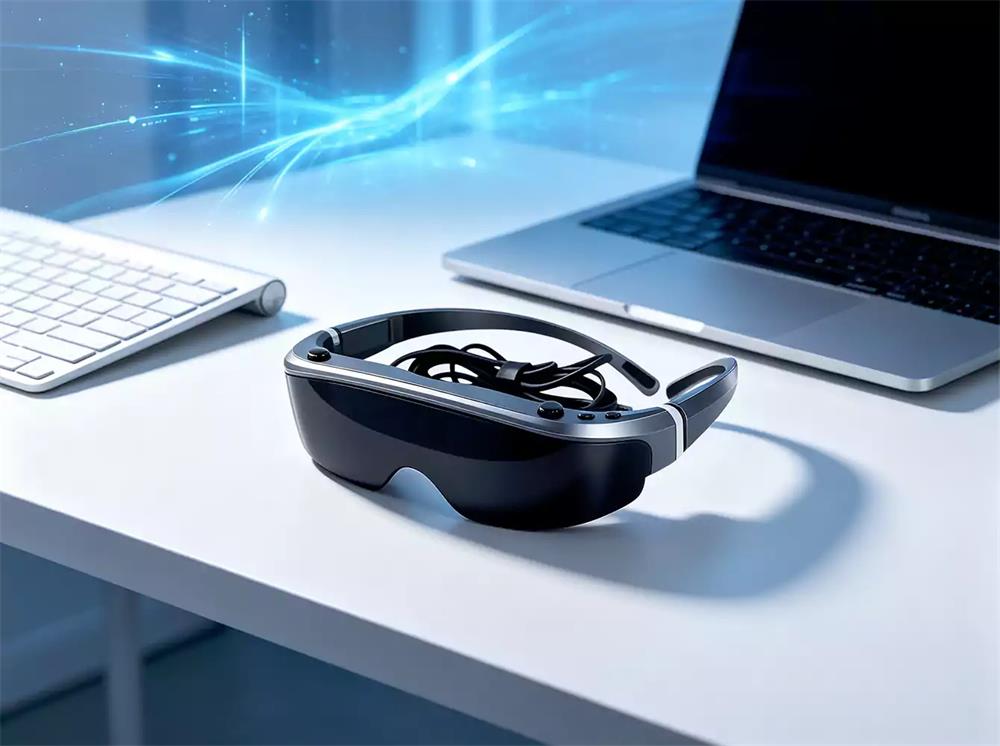
This is exactly where SPAEXI ARPC takes a completely different approach. Instead of making the host smaller, it eliminates all peripherals entirely. ARPC is a two‑piece system: the keyboard IS the computer – a fully functional PC with built‑in CPU, RAM, storage, battery, and a full‑size 65‑key keyboard with touchpad. AR glasses ARE the monitor – put them on and a 120‑inch virtual screen appears, visible only to you. One USB‑C cable connects them. No external monitor, no mouse, no tangled cables.
The numbers tell the story:
-
Total Weight: Traditional setup ≈ 2kg+ vs ARPC 600g (host) + 86g (glasses) ≈ 686g
-
Folded Size: 167×104×26mm (power‑bank sized)
-
Battery: 8000mAh built‑in
-
Setup Time: Under 10 seconds
Four series, four productivity scenarios:
-
FOLDIX (拓界) : Android + Rockchip RK3576 (6 TOPS NPU) – AIoT edge computing, in‑vehicle intelligence
-
FOLDX86 (x86系列) : Windows 11 Pro + Intel Celeron – daily office, web browsing, light productivity
-
POCKET CORE (掌界) : Windows/Linux + Intel Core i5 – coding, design, content creation
-
LingAR AMD (领界) : AMD high‑performance processor – professional multi‑tasking (coming soon)
By pairing lightweight AR glasses with a pocket PC, SPAEXI sidesteps the usual AR pitfalls: heavy headsets, short battery life, and high cost. The result is a spatial computing terminal that fits in your pocket.
VI. The Bigger Picture: Mini PCs Entering the Spatial Computing Era
As Mini PCs converge with AR display technology, a new category is emerging: spatial computing devices. When computer volume has already been pushed to its physical limits, the next breakthrough is no longer "making the host smaller," but "making the entire computer smaller." Traditional Mini PCs solve the "small host" problem. SPAEXI ARPC solves the "small complete computer" problem. It's not the smallest host on the market. But it might be the smallest complete computer you can carry – one that transforms into a 120‑inch private workstation the moment you put on the glasses. In an era where lightweight AI terminals have become the new global computing frontier, SPAEXI ARPC is pointing the way forward. It's not just a Mini PC – it's a new paradigm for personal computing.



 Language
 Tiktok
 instagram
 Youtube
 +86 137-1500-3940
  E-mail