I. Who Is Buying Mini PCs? Three Groups Are Reshaping the Market
In the past, mini PCs were seen as "backup machines," "living room players," or "toys for geeks." But in 2026, the user profile has fundamentally shifted.
The first group is "efficiency‑first mobile workers." They are not satisfied with the performance compromises of laptops, nor do they accept the space occupation of desktops. Mini PCs offer a middle ground – small enough to hide, yet powerful enough to run 3D modeling and lightweight editing. More importantly, with the maturation of dual‑screen portable monitors and the proliferation of AR glasses, the traditional "host + screen + keyboard + mouse" model is being dismantled. Mini PCs can connect to any screen – whether it's a portable monitor on a desk or an AR display worn on the eyes.
The second group is "developers doing local AI deployments." With rising cloud AI service costs and increasingly stringent data privacy requirements, local deployment of AI agents is becoming a new trend. Open‑source AI projects like "OpenClaw" allow developers to run their own AI agents on Mini PCs. The key metrics for this type of demand are no longer CPU clock speed alone, but NPU compute power, power consumption, and 24/7 stability. Mini PCs, with their low power consumption, silent operation, and ability to run continuously, are naturally suited as ideal hardware for local AI deployments.
The third group is "budget‑conscious enterprise procurement officers." Against the backdrop of cost reduction and efficiency improvement, Mini PCs have become a star option for enterprise IT procurement – cheaper than desktops, less expensive to maintain than laptops, and more suitable for standardized deployment. In European and American markets, Mini PCs are progressively taking over retail terminals, digital signage, educational devices, and industrial control scenarios.
These three groups are contributing stable growth momentum to the Mini PC market.
II. Two Paths for Mini PCs: Geek DIY vs. Brand‑Ready Solutions
The current Mini PC market follows two parallel paths.
Path one is the "DIY craze." Represented by Shenzhen's Huaqiangbei district, over 100 companies have entered the mini PC space, with export ratios exceeding 30% and products reaching 80 to 100 countries and regions. The strength of these products lies in extreme cost‑performance – prices at one‑third or even one‑quarter of traditional brands, with core configurations including ARM‑based AI processing capabilities. This path supports a vast global community of makers and tech enthusiasts.
Path two is "brand system integration." Traditional PC manufacturers like Lenovo, Asus, and Acer have launched Mini PC product lines, emphasizing stability, after‑sales support, and software ecosystems. These products offer "ready‑to‑use" experiences, forming complete solutions with branded peripherals, monitors, and docking stations. However, a hidden issue with this path remains – no matter how much you spend, what you buy is still just a "host." Peripherals must be configured separately, and the "portability" of the entire system is significantly compromised.
III. Mini PCs in the Age of Spatial Computing Are No Longer "Just a Box"
If the future of Mini PCs is understood merely as "smaller hosts," they will eventually be marginalized. The real breakthrough is transforming the computer from a "fixed desktop device" into "part of your body."
This is precisely the answer SPAEXI ARPC provides.
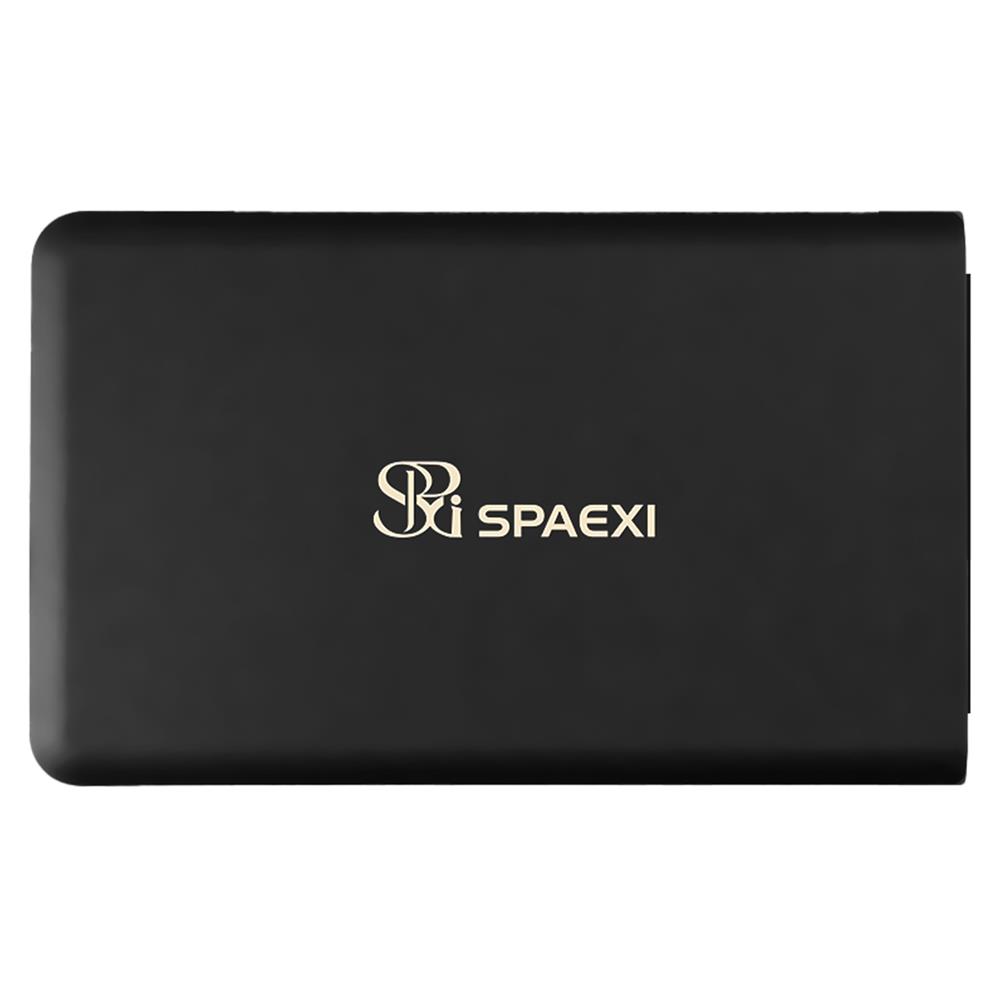
It is no longer a separate "host box," but a foldable keyboard. Unfold it and you have a complete computer. Fold it and it measures just 167×104×26mm – smaller than a typical mini PC host – because it integrates the host, keyboard, touchpad, and battery into one unit. It's not about "making the host smaller" – it's about "making the entire computer smaller." When you put it in your pocket, what you're carrying is a complete computer, not a half‑finished product that still needs a screen and keyboard.
When paired with SPAEXI's AR glasses, it projects a 120‑inch virtual screen – meaning users need neither a physical monitor nor a projector, nor even an extra power cord (thanks to the 8000mAh battery). This also means that ARPC is not just an evolution of the Mini PC, but a terminal form of spatial computing.
Four series, covering four productivity scenarios:
-
FOLDIX (拓界) : Android OS + Rockchip RK3576 processor (with 6 TOPS NPU) – designed for AIoT edge computing and in‑vehicle intelligence
-
FOLDX86 (x86系列) : Windows 11 Pro + Intel Celeron processor – for daily office work and light productivity
-
POCKET CORE (掌界) : Windows/Linux + Intel Core i5 processor – ideal for coding, design, and content creation
-
LingAR AMD (领界) : Powered by an AMD high‑performance processor – for professional multi‑tasking and heavy workloads (coming soon)
From a form‑factor perspective, Mini PC competition has already entered the "spatial computing" dimension. ARPC is attempting to answer a question: when a computer's performance is no longer limited by size, what people truly need is not a smaller box, but a complete work system that can truly be carried anywhere.
IV. Desktops, Backpacks, and AR Spaces – The Ultimate Form of Mini PCs
The Mini PC market in 2026 is no longer a single‑category competition. It has diversified into desktop scenarios (high‑efficiency computing at fixed locations), mobile scenarios (portable terminals in backpacks), and spatial scenarios (wearable work systems paired with AR devices).
SPAEXI ARPC starts from the latter – it is not about building a smaller host, but about designing a complete computing system that can be carried anywhere. Users can connect to a monitor at their desk, use AR glasses during travel, or activate a vehicle display while on the road.
Market research data shows that Mini PC market growth is driven not only by hardware iteration but also by the expansion of use cases. Penetration rates are steadily increasing in areas such as digital signage, industrial control, and edge computing.
ARPC takes this "box" and evolves it into a foldable keyboard, and then into a pocket workstation. It is not a replacement for Mini PCs, but a new answer for Mini PCs in the age of spatial computing.



 Language
 Tiktok
 instagram
 Youtube
 +86 137-1500-3940
  E-mail