I. Three Major Trends in the Pocket‑PC Market
The pocket‑PC segment in 2026 is following three distinct paths.
The first is the “Windows pocket laptop.” The GPD Pocket 4 is a prime example, featuring an 8.8‑inch 144Hz display and optional AMD Ryzen AI 9 HX 370 processor with up to 64GB of memory. Weighing just 770g, it packs a full Windows productivity experience into a tiny chassis. Its modular I/O design also gives it professional debugging capabilities.
The second is the “aesthetic desktop piece.” The AYANEO AM03 focuses on desktop aesthetics with a magnetic flip‑up front panel that hides ports and a “Skyline RGB” light strip, moving away from the traditional “black box” mini PC look. Powered by an Intel Core i9‑12900H processor, it wins fans with both design and performance.
The third is the “AI‑ready compute box.” Represented by the “OpenClaw” device – a palm‑sized ARM‑based mini PC that can run AI agents 24/7 locally, handling cross‑platform operations and automated tasks. In Shenzhen’s Huaqiangbei district, over 100 companies have already entered this space, with exports exceeding 30%.
Each of these three approaches has its followers, but they all share a common limitation: you still need to carry a separate screen, keyboard, mouse, and power cord. A pocket PC solves “making the host smaller” – not “making the entire computer smaller.”
II. SPAEXI ARPC: Putting the “Entire Computer” in Your Pocket
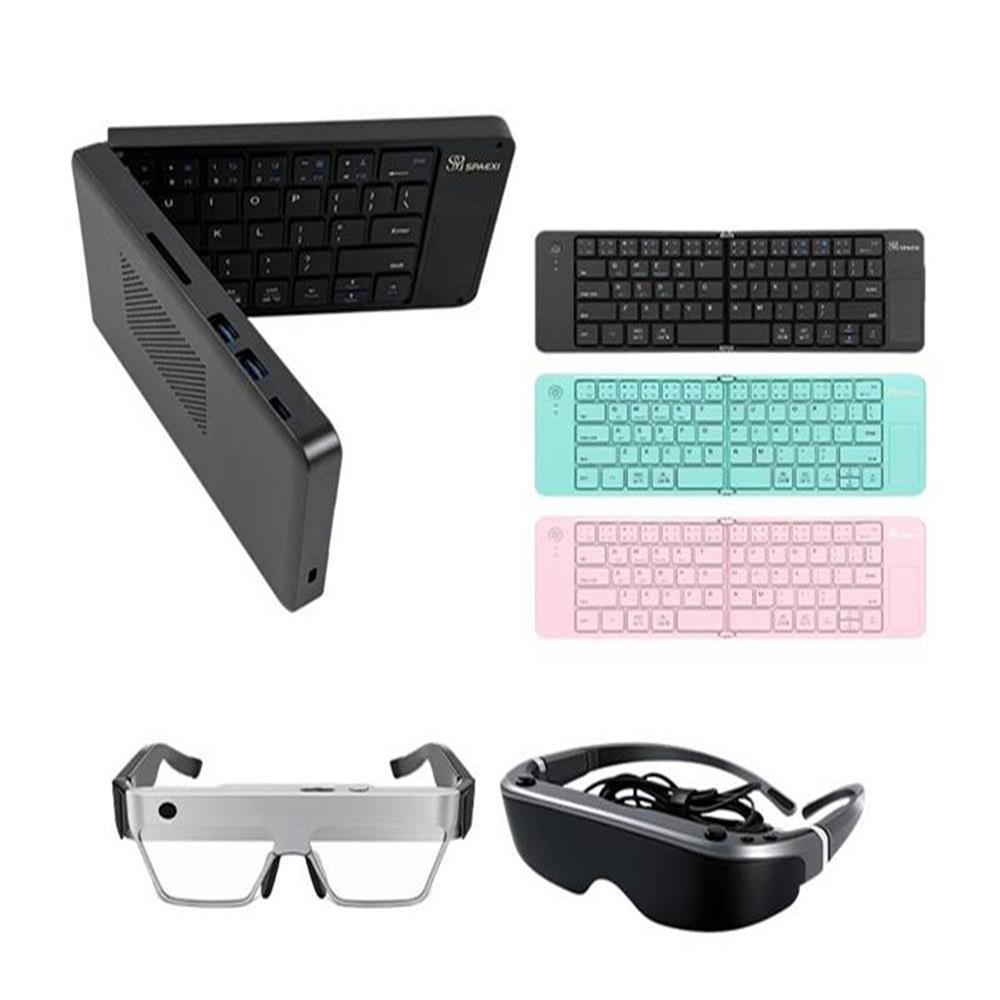
SPAEXI’s ARPC offers a completely different answer – instead of making the host smaller, it eliminates all peripherals entirely.
ARPC is a two‑piece system:
⌨️ The keyboard IS the computer – it is a fully functional PC with built‑in CPU, RAM, storage, battery, and a full‑size 65‑key keyboard with a touchpad. Unfold it and start working – no extra peripherals needed.
🕶️ The AR glasses ARE the display – put them on and a 120‑inch virtual screen appears, visible only to you.
🔌 One USB‑C cable connects the two. No external monitor, no mouse, no tangled cables.
Core differences from traditional pocket PCs:
Traditional pocket PCs solve “making the host smaller” – you still need a screen, keyboard, mouse, and power cord. ARPC solves “making the entire computer smaller.”
III. Four Series, Covering Everything from AI to Professional Content Creation
SPAEXI’s foldable keyboard Mini PC lineup forms a complete product matrix:
-
FOLDIX (拓界): Android + Rockchip RK3576 (6 TOPS NPU) – designed for AIoT edge computing and in‑vehicle intelligence
-
FOLDX86 (x86系列): Windows 11 Pro + Intel Celeron – for daily office work and light productivity
-
POCKET CORE (掌界): Windows/Linux + Intel Core i5 – for coding, design, and content creation
-
LingAR AMD (领界): AMD high‑performance processor – for professional multi‑tasking (coming soon)
All four share the same chassis: unfolding to a 335mm full‑size keyboard, folding down to just 167×104×26mm – about the size of a power bank – and weighing only 600g.
With an 8000mAh battery, it offers 2‑3 hours of continuous use and 4‑5 hours of standby. A single full‑featured USB‑C port handles power, video output, and data simultaneously.
IV. ARPC Is More Than a Pocket PC – It’s the Gateway to Spatial Computing
When paired with SPAEXI’s AR glasses, the ARPC becomes a “Visual‑Spatial Quantum All‑in‑One” – a private 120‑inch workstation visible only to you.
Unlike traditional pocket PCs that merely offer “a larger external screen” when connected to AR glasses, ARPC elevates the combination from flat‑screen computing to true spatial computing. What you see isn’t just a screen – it’s a giant display that only you can perceive.
“The new generation of PCs will no longer be just traditional office computers, but Agent PCs with strong AI reasoning capabilities.” — NVIDIA CEO Jensen Huang, GTCT 2026. This statement precisely captures the future direction of pocket PCs – and ARPC is already on that path.
V. Conclusion
From the GPD Pocket 4’s professional pocket laptop to the AYANEO AM03’s desktop art piece, from the OpenClaw AI compute box to SPAEXI ARPC’s foldable keyboard – the 2026 pocket‑PC market is no longer a single‑minded race for “who is smaller,” but a multi‑dimensional competition of “who understands the use case better.”
ARPC’s answer is: stop asking “how small can the host be,” and instead ask “how light can the whole computer be.”
It packs CPU, memory, storage, keyboard, touchpad, battery, AI compute, and a spatial computing interface into a metal body that, when folded, is smaller than a power bank. It makes high‑performance personal computing as simple, free, and accessible as opening a book.



 Language
 Tiktok
 instagram
 Youtube
 +86 137-1500-3940
  E-mail