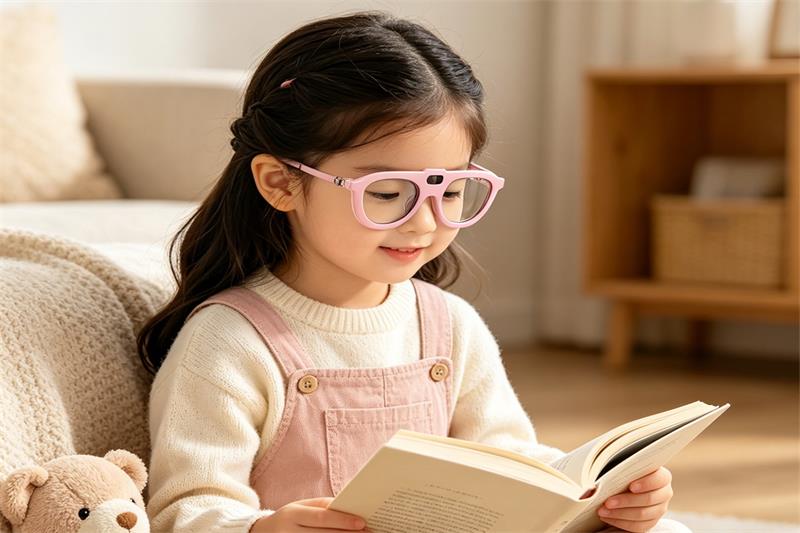
SHENZHEN, China — The numbers are staggering. The World Health Organization has classified myopia as one of the fastest‑growing public health challenges of the 21st century. Today, one in three children worldwide is myopic. The prevalence is rising so steadily that if it continues as predicted, there will be more than 740 million pediatric cases by 2050. An earlier study concluded nearly 5 billion people worldwide – about half the global population – will be myopic by midcentury.
In the United States, the National Eye Institute reports that 9.2 million children and adolescents are already nearsighted. In East Asia, myopia rates among young adults have reached 80–90%. Europe is not spared either – recent meta‑analyses estimate overall myopia prevalence in European children at 7.15%, rising sharply with age from just 3.3% in young children to nearly 50% in adolescents.
The condition is no longer a regional issue; it is a global public health emergency.
Industry Giants Enter the Myopia Management Market, but a Critical Gap Remains
The market has responded. EssilorLuxottica, the world's largest eyewear company, has been actively expanding its myopia management platform. In 2025, it debuted the Essilor Stellest Smartglasses – the brand's first smart eyewear developed specifically for myopia management. Equipped with Essilor Stellest lenses, the device tracks wearing time and patterns, provides behavioral insights, and supports compliance – a key factor influencing treatment effectiveness. The company also launched Stellest 2.0 lenses, which offer significantly improved efficacy in slowing axial elongation – the key driver of myopia progression. In October 2025, the U.S. FDA authorized marketing of Essilor Stellest lenses for children aged 6 to 12, marking a major regulatory milestone.
Meanwhile, Hoya's MiYOSMART lenses have gained traction globally. HOYA Vision Care has expanded its power range to accommodate prescriptions up to -13.00 D and cylindrical power up to 4.00 D, addressing both high myopia and astigmatism. Diffusion Optics Technology (DOT) lenses have now been worn by one million children worldwide.
Yet despite this wave of innovation, a critical gap remains. Most smart myopia solutions focus on lens optics combined with compliance tracking – essentially, they are passive monitoring tools that tell parents and doctors whether a child is wearing their glasses. They do not actively correct the root behavioral cause of myopia: poor posture and excessive near‑work distance.
SPAEXI's Different Approach: "Physical‑Level Active Intervention"
This is where SPAEXI (Shibeixi Technology), a Shenzhen‑based smart hardware company, has taken a fundamentally different approach. Rather than building another app‑based monitoring system, SPAEXI has developed what it calls "physical‑level active intervention" – eyewear that doesn't just track behavior but forces correction in real time.
The company's A03 and A05 children's smart glasses are equipped with electronic fogging lenses. When a child leans too close to their desk (under 30 cm), tilts their head, or adopts poor posture, the lenses automatically fog up, physically blocking the view. The child cannot see clearly until they correct their posture. No parental nagging. No app notifications. No behavioral charts to interpret. Just instant, physical feedback that trains the child's body to adopt healthy habits through repeated, involuntary correction.
Technology That Works Without Distractions
The technology is sophisticated but unobtrusive. The A03 model uses a 6‑axis gyroscope and distance sensor for precise posture and distance detection. The A05 model, designed for children who already wear prescription glasses, employs a laser distance sensor and a 3‑axis gyroscope for even faster response and higher accuracy. Both models use TR90 lightweight frames, with the A03 weighing just 32.6 grams – comparable to ordinary children's eyewear. Battery life is substantial: the A03 offers 40 hours of use and up to one year of standby on a single magnetic charge, while the A05 provides 20 hours of use and 160 hours of standby.
Perhaps most importantly, both models are deliberately free of Bluetooth, cameras, or music playback. Unlike many smart devices that compete for a child's attention, SPAEXI's glasses are single‑purpose: they protect vision and correct posture, and nothing else.
A Practical Solution for Children Who Already Wear Glasses
The A05 model represents a particularly notable innovation. Most children's smart glasses on the market are standalone frames, requiring children who already wear prescription glasses to purchase a second pair. The A05 clips directly onto existing prescription frames, allowing children who already wear glasses to access smart posture correction without replacing their primary eyewear – a practical solution for millions of children worldwide.
The Growing Urgency of Behavioral Intervention
The timing is critical. A 2025 systematic review and meta‑analysis found that 28.8% of children using computers and video games are myopic, with rates rising to 35.4% among those who watch television and 31.4% among smartphone users. As digital device usage continues to climb globally, the need for solutions that address both the optical and behavioral dimensions of myopia has never been more urgent.
A Growing Ecosystem of Smart Eyewear for Children
SPAEXI is not alone in recognizing the potential of smart eyewear for children. Australia and New Zealand's first smart eyewear frame designed specifically for childhood myopia, the LIPO ASTER, was spotlighted at ODMA 2025, featuring habit‑forming and posture‑correcting capabilities. HOYA Vision Care has also unveiled its visuReal MoveAI Kids Module, an AI‑powered video centration system for fitting children's eyewear.
However, SPAEXI distinguishes itself through its dual‑product strategy – offering both standalone (A03) and clip‑on (A05) solutions – and its focus on passive, frictionless correction that requires no parental involvement or app management.



 Idioma
 Tiktok
 instagram
 Youtube
 +86 137-1500-3940
  E-mail