I. Mini PC Market 2026: The "OpenClaw" Effect and the Rise of Lightweight AI Terminals
The volume race among mini PCs has never stopped. In May 2026, Beelink released three mini PCs based on Intel's Wildcat Lake platform, with the EQ Mini featuring a 112×112×37mm chassis that makes it a benchmark for extreme portability. Lenovo's Yoga Mini i measures just 130×130×48.5mm and weighs only 600g. GMKtec's NucBox K13 pushes the volume down to just 0.6 liters. But behind these impressive numbers lies a long-overlooked awkward truth.
II. Small Form Factor PC vs. Portable Workstation: The Peripherals Problem
When a mini PC is small enough to fit in a coat pocket, you still need to carry a screen, a keyboard, a mouse, and a power cord to actually use it. As one industry observer put it: "Mini PCs are compact and lightweight but still require a monitor and power source, giving them limited portability in the true sense." A typical mini PC travel setup—host plus portable monitor plus folding keyboard plus mouse—can easily exceed 2 kilograms. What was supposed to be "portable" ends up weighing more than a laptop. The mini PC solves only "a smaller host," not "a smaller complete computer."
III. Foldable Mini PC + AR Glasses: The Spatial Computing Paradigm Shift
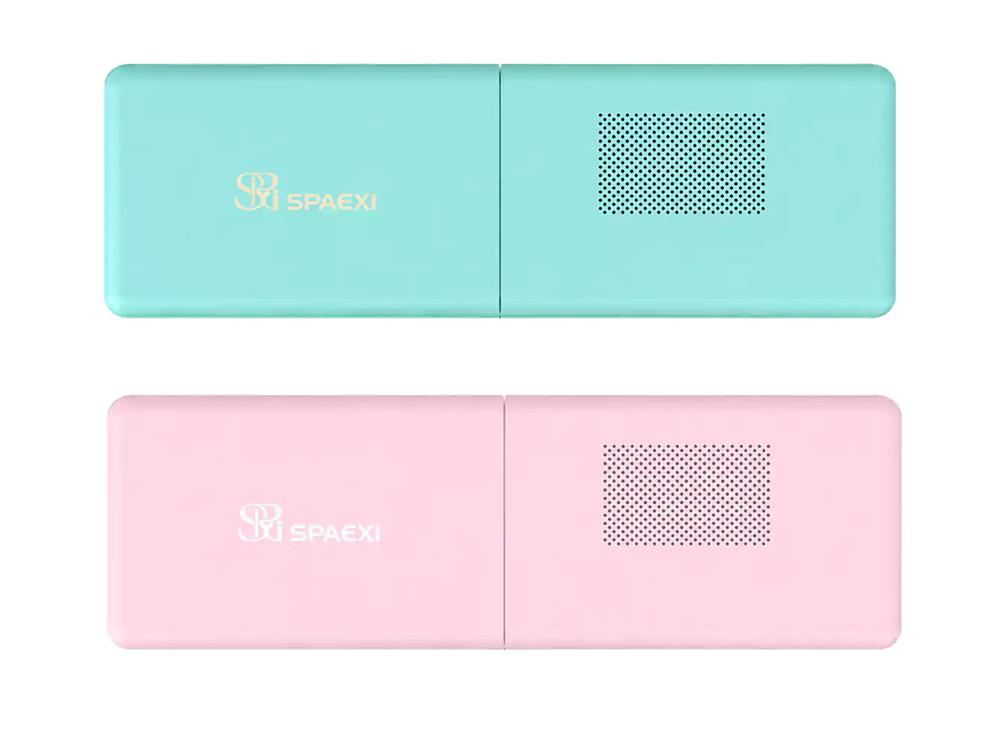
SPAEXI's ARPC takes a fundamentally different approach—instead of trying to make the host smaller, it integrates all the peripherals directly into the system. ARPC is a two-piece system: the foldable keyboard itself is a fully functional PC, with built-in CPU, RAM, storage, battery, and a full-size 65-key keyboard. The AR glasses are the display, projecting a 120-inch virtual screen visible only to the wearer. The two connect via a single USB-C cable. Folded down to just 167×104×26mm—smaller than any mini PC host on the market. The entire system weighs just 600g, plus 86g for the AR glasses, for a total of 686g.
IV. AI PC Workstation: Four Configurations, One Form Factor
SPAEXI's foldable keyboard Mini PC offers four configuration options, covering everything from AIoT edge computing to professional multi-tasking:
|
Series
|
OS / Processor
|
Best For
|
|
FOLDIX
|
Android + Rockchip RK3576 (6 TOPS NPU)
|
AIoT edge computing, in-vehicle intelligence
|
|
FOLDX86
|
Windows 11 Pro + Intel Celeron
|
Daily office, web browsing, light productivity
|
|
POCKET CORE
|
Windows/Linux + Intel Core i5
|
Coding, design, content creation
|
|
LingAR AMD (coming soon)
|
AMD high-performance processor
|
Professional multi-tasking
|
All models share the same foldable chassis: unfolds to a 335mm full-size keyboard workspace, folds down to 167×104×26mm—about the size of a power bank.
V. Portable Workstation 2026: Redefining the "Smallest Computer" in the Spatial Computing Era
As mini PCs converge with AR display technology, spatial computing devices are emerging as a new category. When computer volume has already been pushed to its physical limits, the next breakthrough is no longer "making the host smaller," but "making the entire computer smaller." The ARPC approach—using the keyboard as the PC and the glasses as the screen—offers a completely new way of thinking. It's not the smallest host. But it may be the smallest complete computer you can carry. That is the new definition of "the smallest computer" in the spatial computing era.



 Language
 Tiktok
 instagram
 Youtube
 +86 137-1500-3940
  E-mail