I. The Origins of Mini PCs: From "Barebones" to "Almost a PC"
The history of the Mini PC can be traced back to the "barebone system" era of the early 2000s. At that time, manufacturers began pre‑assembling components such as cases, power supplies, and motherboards to avoid price fluctuations and shipping damage to core components like CPUs, memory, and hard drives, while leaving the CPU, RAM, and SSDs for users to purchase and install themselves. This was the earliest prototype of the Mini PC – a semi‑finished product defined by flexibility.
In 2001, Shuttle Inc. developed the world's first SV mini‑barebone series products. With its lightweight aluminum casing and unique compact all‑in‑one motherboard design, monthly sales grew from an initial 5,000 units to approximately 20,000 units. Shuttle became known as the "founding father" of the mini‑barebone. During this period, mini PCs were primarily targeted at industry users in circulation and financial services, and they did not receive much attention from PC manufacturers among ordinary home and office users.
II. The Golden Age of Intel NUC: Defining the "Mini PC" Standard
The real turning point came in 2012. Intel launched the NUC (Next Unit of Computing) product line – the ambition was written in the name. The motherboard in a standard NUC measures just 4 inches by 4 inches, with the entire unit typically measuring only about 11cm to 12cm in length and width.
Over the next decade, the NUC evolved from a low‑power machine capable only of light office work into a product line featuring larger and more powerful components, optimized for gaming, edge computing, and IoT applications. However, Intel's approach to NUC carried a distinct "big‑company demonstration project" flavor: they sold barebone systems, with memory and storage left for users to purchase separately. Once fully configured, the total price was far from cheap. Ordinary consumers found it too expensive – they might as well buy a laptop – while enthusiasts found it not powerful or expandable enough.
In July 2023, Intel announced that it would cease direct investment in the NUC business. Asus subsequently took over, but product prices visibly climbed – the NUC 14 Pro started at $394, while the flagship ROG NUC pushed straight past $2,000. The affordable entry point for "tinkering on a budget" was suddenly gone.
III. The Rise of Chinese Manufacturers: From "Chasers" to "Definers"
Through that open door came a group of "grassroots" players from Shenzhen – Beelink, Minisforum, and Chuangyingxin.
Chuangyingxin's story is particularly telling. Founded in Shenzhen's Longhua District in 2013, the company initially focused on exporting TV set‑top boxes. In 2014, a European customer casually asked: "Could you make a computer host as small as a TV set‑top box?" That question sparked an idea. The team decided to go deep into this "narrow path."
They launched their first Mini PC in 2015 and became an Intel strategic partner in 2017. In 2019, annual Mini PC shipments exceeded 300,000 units; in 2023, they surpassed 1 million units, making Chuangyingxin the global leader in mini PC shipments. By 2025, total output value reached 5 billion RMB. In the Mini PC segment, Chuangyingxin spent over a decade digging "one centimeter wide and one kilometer deep." Its total shipments now account for approximately 15% of the global market – Shenzhen‑made Mini PCs are now on desks around the world.
IV. The "Last Mile" Problem of Mini PCs
Yet behind all this success, a fundamental problem remains unresolved: the host shrank, but the peripherals didn't. A typical Mini PC setup – host + portable monitor + folding keyboard + mouse – easily exceeds 2 kilograms. It solves only "making the host smaller," not "making the entire computer smaller."
V. SPAEXI ARPC: A Foldable Keyboard Redefines the "Pocket Computer"
It is against this backdrop that SPAEXI's ARPC offers a completely different answer – instead of making the host smaller, it eliminates all peripherals entirely.
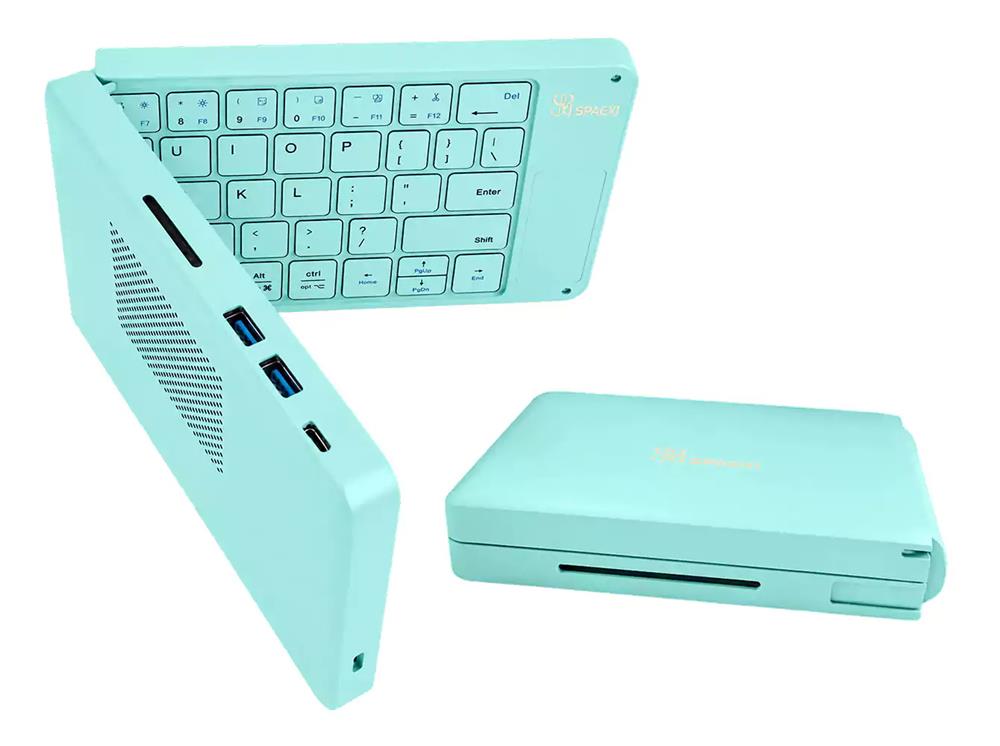
ARPC is essentially a two‑piece system: the keyboard IS the computer – it contains the CPU, RAM, storage, battery, and a full‑size 65‑key keyboard with a touchpad; the AR glasses ARE the monitor – put them on and a 120‑inch virtual screen appears, visible only to you. The only cable is a single USB‑C connecting the two.
This solution solves the Mini PC's "last mile" problem. Traditional Mini PC users traveling for business need to carry a host, a portable monitor, a folding keyboard, a mouse, and a tangle of cables – a "portable" setup that weighs more than a laptop. ARPC users need only a 600g foldable keyboard host and a pair of 86g glasses – a total of 686g, lighter than a 13‑inch laptop.
SPAEXI offers four configurations, covering everything from AIoT to professional computing:
-
FOLDIX (拓界) : Android + Rockchip RK3576 (6 TOPS NPU) – designed for AIoT edge computing and in‑vehicle intelligence
-
FOLDX86 (x86系列) : Windows 11 Pro + Intel Celeron – for daily office work and light productivity
-
POCKET CORE (掌界) : Windows/Linux + Intel Core i5 – for coding, design, and content creation
-
LingAR AMD (领界) : AMD high‑performance processor – for professional multi‑tasking (coming soon)
All models share the same foldable chassis: unfolding to a 335mm full‑size keyboard, folding down to just 167×104×26mm – about the size of a power bank. An 8000mAh battery provides 2‑3 hours of continuous use and 4‑5 hours of standby. A single full‑featured USB‑C port handles power, video output, and data simultaneously.
VI. Conclusion
From Shuttle barebones to Intel NUC, from Chuangyingxin's million‑unit shipments to SPAEXI's foldable keyboard – the 20‑year evolution of the Mini PC is essentially a history of "making computers smaller." But Mini PCs had always remained stuck in the dimension of "making the host smaller." SPAEXI's ARPC extends "folding" from the keyboard to the entire computer, creating a truly foldable, all‑in‑one computing device.
While traditional Mini PC manufacturers are still competing over who can make the smallest host, SPAEXI has already put the "entire computer" into a pocket. This is not just an evolution in form factor – it is a fundamental redefinition of what "portable computing" really means.



 Language
 Tiktok
 instagram
 Youtube
 +86 137-1500-3940
  E-mail